Smithers (over loudspeaker): Attention Homer Simpson. You have been promoted. You are now an executive. Take 3 minutes to say goodbye to your former friends and report to room 502 for reassignment…to a better life.
Simpson and Delilah
The Simpsons: Season 2, Episode 2
My experience with workplace hierarchy kind of went in reverse. My first permanent job was in a small factory run by 2 brothers. I was hired for the purpose of learning how to run the warehouse. It was a small business with only two other employees there before me. Two blokes old enough to be my dad and very set in their ways. The bosses’ wives ran the reception and office. One more bloke came on after me and that was it.
They sent me to TAFE to study supervising and management and somewhere in my 2nd year I slipped into the warehouse manager position. Up till then the older of the veterans (Nick) considered himself in charge and was my first look at two workplace archetypes I would come across all through my working life:
- The long-term worker who sees his years of service as a reason to do as little as possible.
- The unappointed ‘supervisor’ who sees this position as a reason to do as little as possible. I will never know if he just thought it made him look busy or if he genuinely believed it was important, but he would sit down and peruse the invoices 3 or 4 times a day! Just moving them from one pile to another.
He wasn’t bossy or rude, just very stubborn. Me and the other guy followed his lead simply because he had been there the longest. I don’t recall any big announcement of me taking charge and I didn’t notice any friction; how would you? The 2 bosses couldn’t get Nick to change his ways, what chance did I have?
I found the whole experience to be a frustrating and exhausting one! TAFE was interesting and I learned plenty of theory, yet not much of it translated to the real world. Eventually I would quit and move on to zero responsibility and lots of beer guzzling at the happy house of hazards. I was truly happy for a while there too.
That was around 25 years ago, and I have not taken a leadership role since. I have seen the whole gamut of supervisors, managers and higher ups. Not too high of course, you can see so much from the bottom. I am fascinated by the antics of these individuals and even more intrigued about their motives and expectations regarding taking the job.
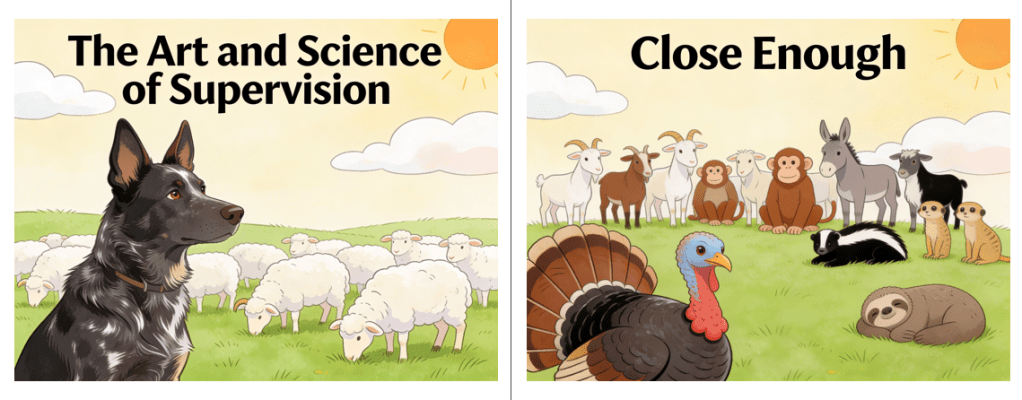
Way too many were variations on Nick from my first job. Being the ‘supervisor’ meant that you didn’t have to do much work. I was about to write ‘physical’ work, but these people don’t seem to exert much mental effort either.
Singing Whale: Do you know what Headman really does?
Gecko Lizard: He bosses people around.
Singing Whale: No. He does what is best for the people.
Gecko Lizard: By bossing them around.
Singing Whale: Gecko Lizard! You really are dumb!
2014

I cannot remember the exact list of required duties for a supervisor (first line manager), but it was the first thing we learned at TAFE. Something akin to:
Plan: Day to day or week to week at the most. The higher you move up the ladder the further ahead your planning will need to be.
Organise: Putting the plan into action. Setting the schedule and delegating the tasks.
Communication: Ensuring all our workers know what is expected of them and reporting back to management regarding performance, along with any issues or suggestions from the staff.
A very simple formula, yet not an easy task. I reckon most people would be lacking in at least one of these aspects in general and when you start going deeper, the flaws will be exposed even more: Problem solving, time management, conflict resolution, decision-making, mentorship, interpersonal skills etc. That’s a lot to ask of someone who just wants to get out of doing manual labour.
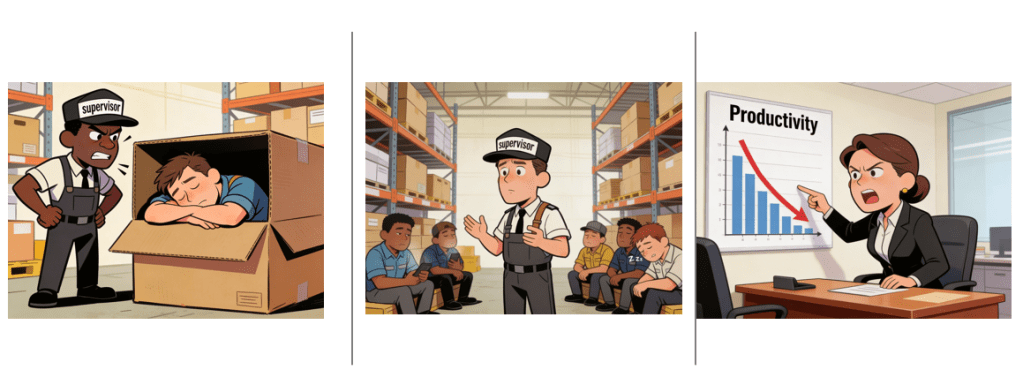
I do not believe that becoming a supervisor in a boring-ass, dead-end job was anyone’s goal as a kid. I’m sure some people take on the role with noble enough intentions; I am also sure that these people are the minority. The majority are either lazy, old, tired and/or carrying an injury, or a self-important wanker. It could be a mix of all these.
I’ve seen all kinds: The guy who used to tell us all that he had worked for the company for 30 years as if it was a badge of honour and we should defer to him for this reason. When he realised people viewed his lack of upward mobility in that time as a fault, he became a supervisor. He didn’t make it to the next year. He was hopeless in pretty much all the required traits. He knew how to do the job on the floor fine, but that does not automatically translate to being a leader and it’s especially difficult when people openly mock you.
I think people take moving up the ladder way too lightly; they only see the (very few) good points. You may get a pay rise, but that often comes with a lot of unpaid overtime and/or phone calls out of hours. In a lot of cases, you may escape the grunt work. However, you now are responsible for getting the grunts to be productive. All those different personalities and degrees of work ethic. For some people doing as little as possible is a matter of principle more than just laziness; it was for old Nick.
Speaking of that place, I not only had to get my hands dirty, but I had to do extra work because wild horses couldn’t get Nick to move his ass and the bosses would not sack him. So, watch out for that pitfall too.
I’ve got plenty more to say about this stuff so I will most certainly be coming back this way again soon.
 MINDLESS MUSINGS
Leave a comment