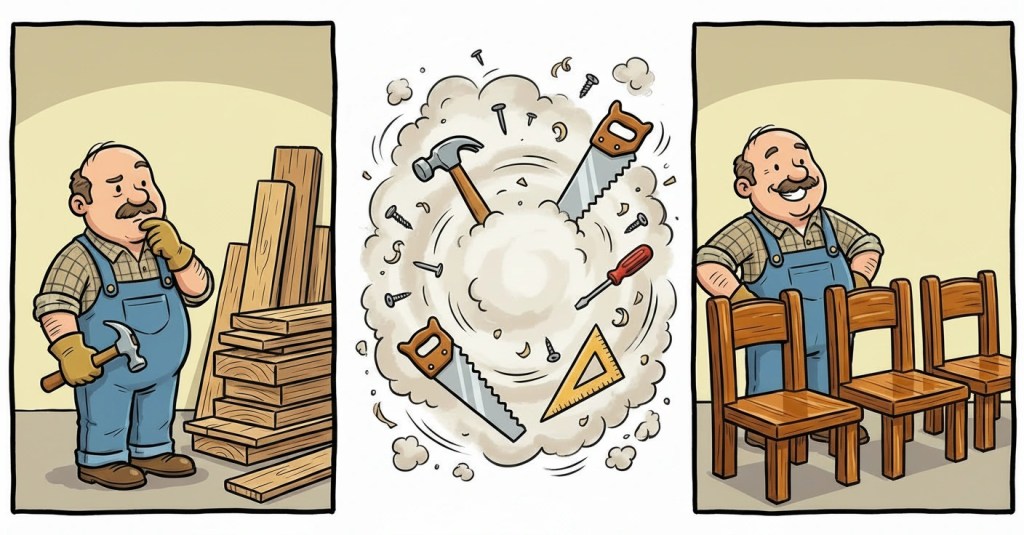
Joe has mastered the craft of building chairs. He has made a few and they are selling well. He charges $20 for each chair. It costs him $7 to buy the wood and nails to make 1 chair. It takes him around 12 working hours to make 1 chair. $13 profit = $1 an hour for Joe with $1 leftover. He saves those dollars for a rainy day and makes 5 chairs a week. That’s $100 for a 60-hour week. $65 profit. For reference, let us say that the average rent is $20 a week. Joe’s doing pretty well for himself.
To avoid complication, I will leave out taxes and any innovations or efficiency improvements. It’s just Joe, his skill, his tools and the raw materials.
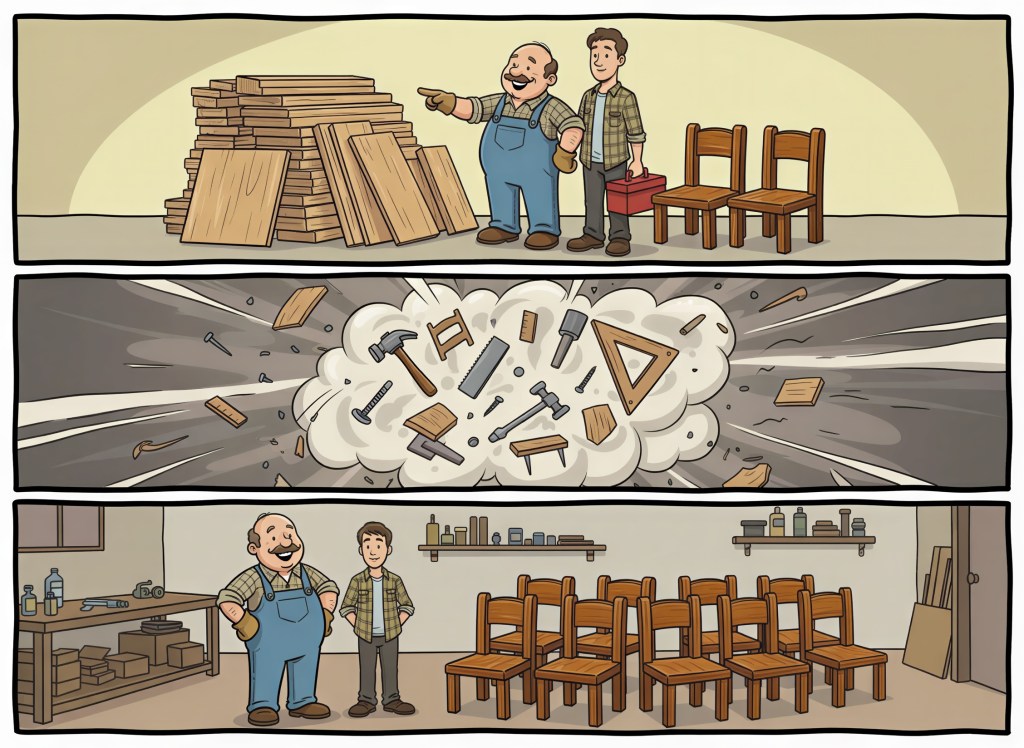
The chairs are selling like hot cakes, and Joe realises that he cannot keep up with demand; Joe is going to need to employ another chairmaker. Again, for simplicity I will skip an unskilled assistant or apprentice. Joe hires a craftsman that has his own tools and can build one of his chairs in 12 hours.
Now Joe has doubled production and is making 10 chairs a week. After purchasing double the wood and nails, the profit is now $130. Of course, Joe must pay his new employee (#2) out of that money. Here we hit the first bump in the capitalist road. Joe hypothetically estimated his pay at $1 an hour. #2 is doing exactly the same work as joe. Should he also get $1 an hour?
A Marxist may very well insist on it; anything less is exploitation. Before we explore the gamut of business expenses, let’s assume there are none. Joe started the business and Joe designed the chairs. Joe fronts the money for the raw materials and Joe got the demand increased before #2 arrived.
If you were Joe, would you split 50/50 with #2?
If you answered no, then I guess you can stop here.
If your response was yes, let’s look at the most basic of overheads:
- The work takes place on Joe’s premises and Joe is responsible for its maintenance.
- Joe foots the bill for utilities.
- Joe also takes the loss for mistakes resulting in waste.
- He cops the hit for returns and refunds.
Is an equal split still appropriate?
A hard-core socialist might say yes. I am by no means a free-market capitalist, especially when it gets to the extreme ‘profit above all else’ larceny. There certainly needs to be checks and balances on the profit-margin moguls. On the other hand, if there were no rewards for taking the risk of starting a business venture there would be a massive decline in entrepreneurship.
What would be the point of Joe expanding his business if every new employee shared the profits, but none of the expenses or risks? There is scope here for a new type of business model, but that is another exercise. A brief hypothetical question though: To get an equal share of profits, would you be okay with the boss deducting expenses from your pay?
A better example might be this: If a doctor got paid the same minimum wage as everyone else, how many doctors do you reckon there would be? You can even include free education if you like. It’s a hell of a lot of gruelling study and the responsibility and pressure on you is more than a little full-on compared to loading supermarket shelves.
I’ll say it again; I detest the outrageous profits we are seeing while people struggle to survive. However, just because one loathes an extreme, it is not necessarily a good idea to swing over to its opposite. I apologise for being a bore, but moderation is important in most cases.
I will stop trying to convince invisible (and possibly non-existent) people. I am merely laying out my thoughts so I can observe them more clearly.
I like the Joe analogy. I reckon I will follow his progress as his business grows and grows. I am fascinated by where it will lead. I get a feeling he is going places.
 MINDLESS MUSINGS
Leave a comment