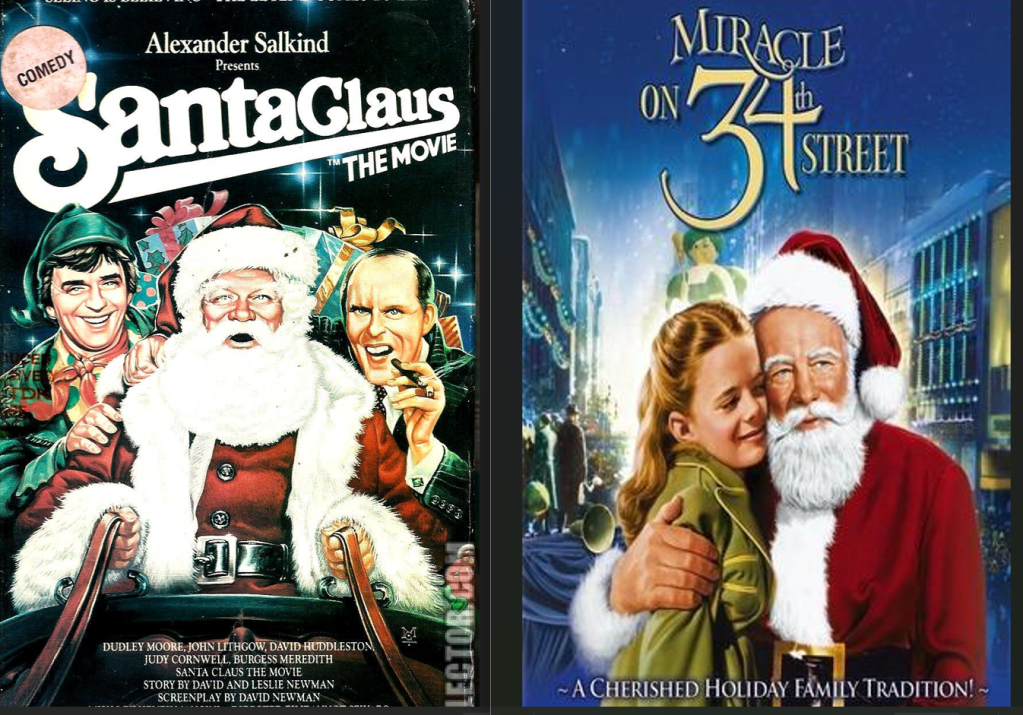
The later film was made 40 years ago from today what’s more! That film was called “Santa Clause: The Movie” (1985). It begins with an origin story, but the drama takes place in the present – or that present – the present time the movie was released – 1985! The other film was titled “Miracle on 34th Street” (1947) and was a hypothetical story about Santa getting caught up in modern New York Christmas antics – modern as in…1947!
Two rather different tales involving Santa Clause with one very similar theme: the commercialisation of Christmas. The next time someone complains about it like it is a present-day problem, remind them that is has been a ‘modern’ phenomenon for a very long time. This similarity is to be expected when a story places the altruistic Kris Kringle (or one of his elves) amongst the materialistic world of toy sales at Christmas time. The intriguing parallel of the two movies is the way the ‘capitalist’ characters see how they can turn this selflessness into a profitable endeavour.
The first film (made nearly 80 years ago) is a little more cryptic. There is no overt magic, and we are never shown outright that this bloke is really St. Nick. The magic derives from the ‘spirit of Christmas’ and the kindness and wonder it inspires. The corruption of Christmas is best demonstrated in the scene where Kris is preparing for his first day as the store Santa at Macys.
The manager instructs Kris that if any kids are unsure of what they want he should persuade them to ask for any of the products the store is overstocked with – cunning huh. Not only does he not follow the directions he lets any kid (or their parents) know where they can find toy that Macys may not have, even if it is in a competitor’s store – the audacity!
Naturally management is horrified by this, but before they fire Kris, they discover a strange side-effect of this incredible generosity – people are proclaiming their newfound loyalty to Macys as a result of such goodwill. By showing that the wishes of the children come before profit Macys (by default) have shown that they are the store with real heart.
The top brass is quick to pounce on this marketing marvel, and this is best summed up by this monologue:
“Never in my entire career have I seen such a tremendous and immediate response to a merchandising policy and I’m positive Frank if we expand our policy, we’ll expand our results as well. Therefore, from now on not only will our Santa Clause continue in this manner, but I want every salesperson in this store to do precisely the same thing. If we haven’t got exactly what the customer wants we’ll send him where he can get it. No high pressuring and forcing a customer to take something he doesn’t really want. We’ll be known as the helpful store, the friendly store, the store with a heart, the store that places public service ahead of profits and consequently we’ll make more profits than ever before.”
And there it is. The insincere hijacking of altruism. The absurdity escalates as competitors frantically try to cash in on the phony selflessness scheme. Such a brilliant and funny way to display such an ugly symptom of capitalism. The film is considered a classic for a reason.
Fast forward to 1985 and Ronald Reagan’s America. Only two years before Gordon Gekko would make his quintessential 80s “Greed is Good” speech in “Wall Street”. The 80s was famous for decadence and the next film came out smack bang in the middle of it. “Santa Clause: The Movie” was released in 1985 and our greedy industrialist is named B.Z. (played by John Lithgow). We first meet him at a senate enquiry where the ludicrous hazards to children posed by the toys he manufactures is on full display. B.Z. is forced to recall all his deathtraps and is obviously upset about the loss of profits.
Santa is of course the main character, but his relationship with an inventive Elf called Patch (Dudley Moore) is a key one. Upon feeling he has let Santa down Patch heads for the big city determined to create an amazing toy that will bring joy to all the children for Christmas and thus make Santa proud of him again.
Unfortunately, this big-hearted innovator stumbles on none other than B.Z. and being innocent decides to give his latest and greatest creation to this toy manufacturer. Their first meeting encapsulates the contrast between the ‘spirit of Christmas’ and the exploitation of it.
Patch tells B.Z. about his plans to create a wonderful Christmas gift for all the boys and girls. B.Z. listens to the pitch with indifference. The first time we see him react is when Patch informs him that the doesn’t know much about money – B.Z. is most pleased with this. After B.Z. explains advertising to Patch we get to the part of the scene that captures our theme perfectly once more:
B.Z.: How many workers does this…uh product require?
Patch: Just me
B.Z: What no payroll?
Patch: Well, my needs are simple, a bowl of stew heavy on the dill. A cold place to sleep.
B.Z: Wh wh what would it cost?
Patch: Cost? Cost who?
B.Z: The people who, who buy the toy?
Patch: Well, nothing we’re gunna give them away free.
(B.Z recoils in stupefied horror at the sound of this – gagging and gasping for air.)
Patch: Oh, oh that’s fantastic! How do you turn your face so red so fast?
B.Z: FOR FREEEEE?!?!?!
Patch: Well, that’s how we do it at the North Pole
B.Z: Well that’s not how we do it here in a free enterprise system!
It is at this moment that B.Z. makes the marketing of altruism connection. The difference this time is even more scummy than the Macys ploy. B.Z. plans to use this inconceivable gesture to improve his ‘public image’ and even says “it’s not a bad investment”. The profit and loss calculations never leave his head. Yes, it is possible for B.Z., and all those like him, to be generous and take a loss. So long as there is some kind of future gain to be had – in this case it’s public relations.
Altruism is a fundamental part of Santa and the Elves’ nature. For B.Z is a great PR tool and for the department store heads at Macys it was a ‘merchandising policy’. Either way it has a genuine ability to spread joy. For some that joy is the point, for others it is a way to make a buck.
Naturally Santa succeeds in the end and kindness conquers greed. B.Z is punished and Patch is joyfully reunited with the man in red. “Miracle on 34th Street” doesn’t go after the heartless retail moguls, but one spiteful underling does get fired. The victory in this film goes to the ‘spirit of Christmas itself’. Both movies celebrate the defeat of not just a villain, rather the triumph of goodwill over cynicism – we can dream can’t we?
 MINDLESS MUSINGS
Leave a comment